Skip to Content Skip to Footer
New Jersey WIC logo
New Jersey Wic Logo
  • English
    • Español
    • العربية
    • বাংলাদেশ
    • Creole
    • Polskie
    • Português

Infant Feeding Guide

  • Home
  • Feeding Your 0-3 Month Old
Download

Feeding Your 0-3 Month Old

Infant lying on back and looking up
Newborns have tiny tummies and need to be fed often. Watch your baby’s feeding cues. They will tell you when they are hungry and full. In the first few weeks, you may sometimes need to wake your baby to feed.
Feeding Cues
I’m Hungry
I’m Full
I’m Hungry
  • Stirring
    Sucking on hands or
    lip-smacking
  • Mouth opening
    Head turning to look for
    the breast
  • Turning head seeking/rooting
    Opening and closing mouth
I’m Full
  • Sucking slows or stops
    Relaxes their body and
    opens their fists
  • Hands/arms relax
    Turns away from your
    breast or nipple
  • Turns or pushes away
    Drifts off to sleep
Growth Spurts
All babies will experience many growth spurts in the first year. They can cause your baby to want to feed more often. Growth spurts typically happen when your baby is around 2-3 weeks, 6 weeks, 3 months and 6 months old. Growth spurts may not happen at the exact time, and every baby is different. Growth spurts usually last a few days.
Two to three week old baby sleeping
2 to 3 Weeks
Six week old baby resting comfortably

6 Weeks

Three month old baby during early development

3 Months

Six month old baby sitting with support
6 Months
Breastfed Infants
  • Breastfeeding in the beginning is a time when you and your baby are learning. With time, you both will find it easier.
  • Newborns breastfeed throughout the day and night about 8-12 times in 24 hours. They are not on a schedule and love to feed often.
  • Whether baby is breastfed or fed pumped breast milk, feed your baby when they show signs of hunger.
  • Giving only breast milk for the first month will help you establish a good milk supply for the future.
Infant daily sleep routine icon
During a growth spurt your baby may nurse longer and more often. This is called cluster feeding.
Formula Fed Infants
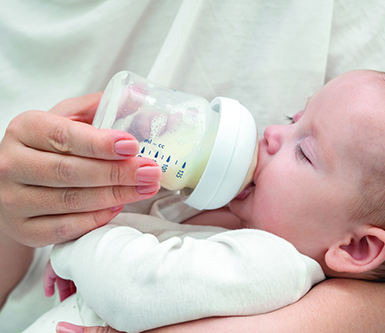
When your baby is first born, they only need 1-2 oz. of iron-fortified infant formula at a feeding. After the first week newborns usually take 2-3 oz. of formula every 3-4 hours.

6-8 lbs.:

15-20 oz.
per day

8-10 lbs.:

20-25 oz.
per day

10-12 lbs.:

25-32 oz.
per day
  • By the end of the first month, your newborn may take up to 4 oz. every 4 hours.
  • Feed your newborn whenever they show signs of hunger.
  • It is OK if your baby does not drink the whole bottle, let them tell you when they are done.
Baby being bottle fed illustration
Paced bottle-feeding allows your baby to tell you when they are satisfied/full. For more information, ask your WIC Nutritionist or Breastfeeding Peer Counselor.
Paced Bottle Feeding by The Milk Mob
New Jersey Footer Logo

Contact Us

1-800-328-3838 (24 Hrs) www.state.nj.us/health/fhs/wic/

Learn More

  • How to Apply
  • Find a Clinic
  • Where can I shop?

Resources

  • Nutrition Education
  • Breastfeeding
  • WICShopper
  • eWIC Customer Service

This institution is an equal opportunity provider.

Cookie Policy Privacy Policy

© Brush Art Corporation

  • Email
  • SMS
If you are using multiple emails, separate them with commas.

    SMS Communication Consent